“What if . . . ?” Creating Hope and Positive Momentum to Feeling Better

As a therapist, I am always looking for ways to introduce hope and open the door to feeling better. Sometimes we get stuck in feelings that do not feel good.

The Focus Being on the Positive “What If . . . ?” opposed to the Negative “What If . . . ?”

We all have probably at one time or another said with worry, “What if it doesn’t work out?” “What if the doctor’s report comes back bad?” Etc. These are normal. The “What If . . . ?” I am introducing is flipping the script on these negative “What If . . . ?” to positive “What If . . . ?” This can help open us to hope and a way to better feelings.

Our Feelings Are Our Guidance System

I am not discounting upset feelings. In fact, I embrace and accept and acknowledge all feelings. As I know that this is the first step in our journey to feeling better. As time goes on and we feel heard and validated, we can begin to work toward letting some hope and good feelings in.

Note: If we are talking about trauma or significant depression or mental health issues this may be a longer road and many times with the help of a licensed therapist or mental health provider.

Examples of Positive “What If . . .?”

“What if I feel better today?”

“What if something good happens today?”

“What if we get along better today?”

“What if I feel less sad today?”

“What if I eat at least one good thing for me today?”

“What if things work out for me?”

“What if I feel more peaceful today?”
Photo by Letu00edcia Alvares on Pexels.com

What do your positive “What If . . . ?” starter sentences look like? Start your day out with what makes sense for you at the time. For an extra boost, go back to your positive “What If . . . ?” if you feel your self going negative. You can acknowledge the upset and then go to your positive “What if . . ?” that can make you feel better. Best wishes in using this strategy to feel more hopeful, letting in better feelings.

Important Note: This blog is not therapy but a psycho-educational article. If you have a trauma background or significant depression or other mental health issues, a licensed therapist or mental health provider would be best to consult with.

Strom Individual & Family Therapy – Tanna K Strom, LMFT, LPC-S, RPT-S and Clinical Certified EFT Practitioner. Providing In Person and Online Services in Oklahoma. www.stromtherapy.com

Create Your Own “Feel Better” Plan

Many of you are in a place where you are struggling to keep your anxiety and depression at bay during this health crisis our nation is experiencing. I have many resources I will be sharing in the weeks to come. But first I thought it may be helpful to look at how to structure a general “Feel Better” Plan that is customized just for you.

Here are some of the steps that can assist you in individualizing a plan that is a fit for you and works best for you specifically.

  1. Create a plan that is best for YOU, not what someone else may say is the best for all. There is no one size fits all.
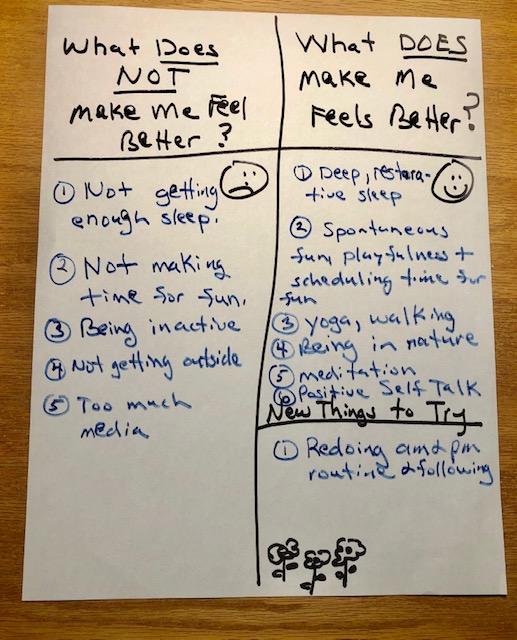
  2. To organize your thoughts you might start with a sheet of paper and draw a line down the middle, determining what does NOT make you feel better and what does make you feel better. 
  • One side for, “What Does Not Make Me Feel Better at This Time?”
  • The other side, “What Does Make Me Feel Better At This Time?”
  • You can add to the Feel Better Side near the bottom a horizontal line with a title “Possible New Things to Try”
  • You may need more than one sheet to collect all of your ideas.

3. Set aside some quiet, uninterrupted time to reflect and think carefully about these questions that will assist you in putting together this general plan to help make you feel better. 

4.  Put this visual FEEL BETTER PLAN up on your frig or on your mirror, etc. as a reference to go to when you needing some concrete ideas. Many times when we are upset it is hard to think clearly, thus a solid plan to look back at when needed.

5. Use an electronic folder to collect items that you are sent or you come across or find that you feel are helpful in lowering anxiety or depression or makes you feel better. I get good ideas on a daily basis from a variety of sources but without  putting them in an central place, they just simply get lost. I am not perfect about doing this but I do try and it has helped when I want to refer back to something. Some of these come in form of a video or an audio format, so the electronic folder is helpful.

6. Make a routine that fits for you. Many professionals feel that a routine can be helpful in assisting you to feel better. What kind of structure and what it looks like is a very individual thing. Structure can make you feel more safe when things around you may not feel stable or controllable.

  • Consider the beginning and end of your day for a routine that makes you feel safe, nurtured and hopeful.
  • Routines do not need to be rigid or stressful or overwhelming. They are intended to make us feel better.

7. Fill your day with things that make you feel good.  The more you can fill your day with things that make you feel happy or safe or bring a smile to your face, the better you will feel.  These interventions can be small and interspersed throughout the day. It may actually be better to spread out these uplifting activities. They can be intentional and spontaneous. When you find healthy things that really make you feel good, do more of them. It will serve you well.

I recently heard a meditation podcast in which Gabrielle Bernstein  said “It is good to feel good.” This is a very fitting, ending remark. It is good to feel good! My best wishes to you all in finding your own way to feeling good.

I will be adding “feel better” resources in the weeks to come for you to choose from as you create and continue to add things to your “Feel Better” Plan.

Professional Disclosure: This blog is offered as educational information and is not offered as professional therapeutic services. This is not intended as treatment. For professional help contact your local mental health professional. Strom Individual and Family Therapy is not liable for any action or non action you take in regard to this article.