How to Create More Peace, More Fun, More Joy

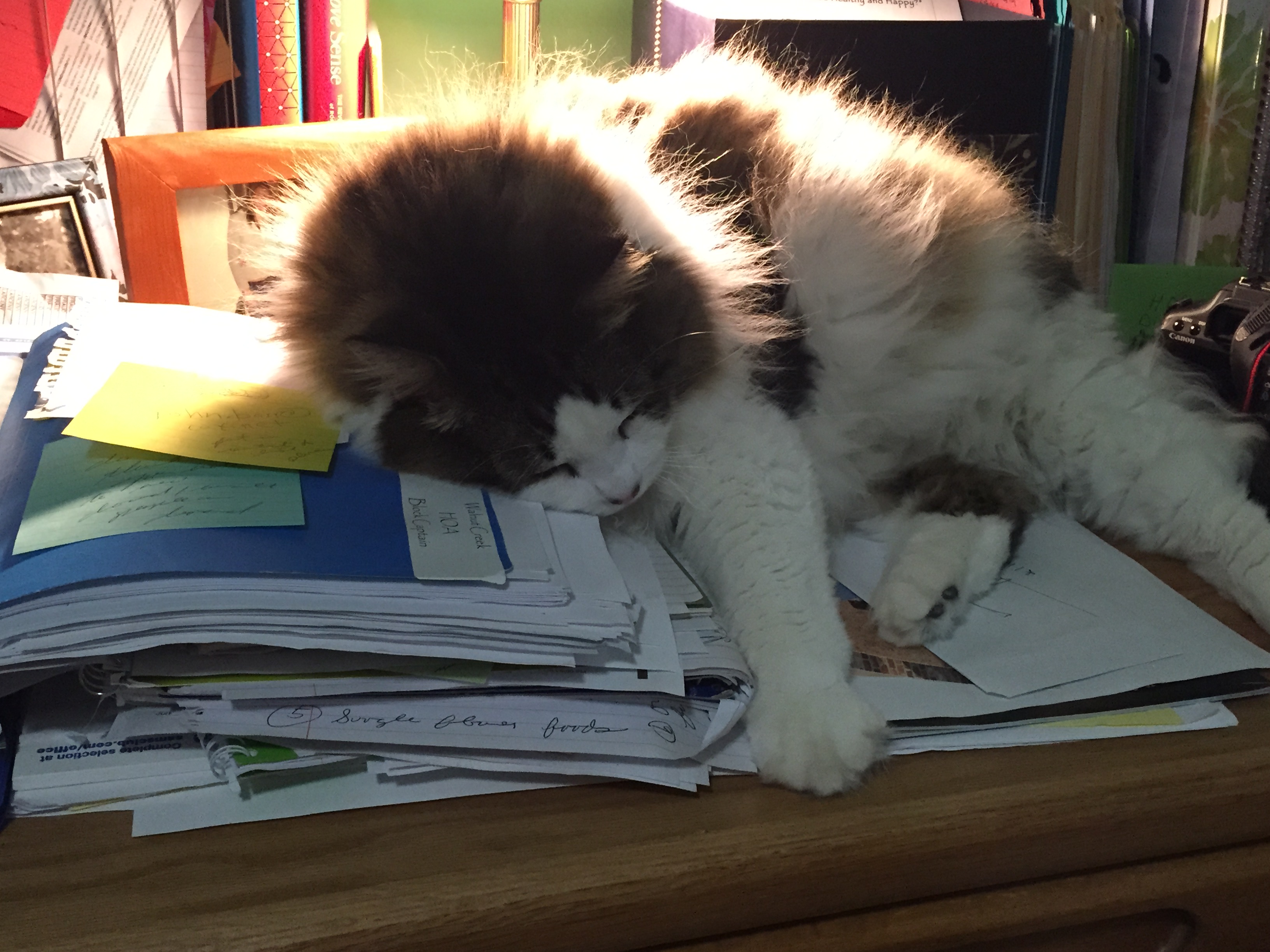
Cat resting on top of my desk papers

How high is your paper pile? As you can see mine had gotten pretty high. My kitty cat has reminded me it is time to take a break. Sometimes it takes an outside source for me to slow down and regroup. But many times I find if I listen to that small voice within I know when it is time to take a break and refresh. What are some of the signs that tell you it is time to slow down?

Here are FIVE sure signs that you may need a break.

  1. You continue to have accidents, maybe small ones, like running into things, dropping things, finding you have made mucho many mistakes in emails you have sent out, etc.
  2. You cannot find things. Maybe you find your keys in the refrigerator. Not good!
  3. You find your communication has gotten shorter and curter and more to the point. You find you are in conflict more with your loved ones.
  4. You don’t feel you are enjoying life. There is no time for that. You are too busy!
  5. You have a sense of unease that tells you that all is not well. Or you may not feel well straight up. Our bodies are “our friends”. They try to tell us when we are going “too fast” or needing to regroup. In fact, most of us will eventually just get sick and our bodies will just shut us down if we don’t listen.

There are times for all of us that we just feel it is all too much and we need a break. So why don’t we? Good question. Sometimes it really does feel like we don’t have a choice. We are under a deadline or someone else is counting on us and we don’t want to let them down. We might worry what others might think. Or it may be that we have just got in a “habit” of being too busy.

It may not really be so much about how much we have going on in our life, but how we perceive it. Are you a half full or half empty person? Our thinking effects how happy we are and how we cope with everyday stressors.

All this said, we still all need to relax and recuperate – taking time to do something that is just for us or do something that brings us immense joy. Of course the best is when we can fill our life with things that bring us joy and happiness. It is also important to note that we all have our own special speed that feels best for us. Some folks just operate at a higher frequency level. That is ok as long as it feels good and it brings us feelings of happiness.

So to end here are FIVE ways to have more PEACE, more FUN, more JOY.

  1. Put a protective shield around yourself. Imagine whatever image works for you. For example: A bright, white protective light around yourself that keeps you calm and stable and not affected by outside pressures and upsets. At a self-care workshop I did for therapists, I had one participant use a super hero cape to wrap around herself. You will have your own image come to mind. This protective shield is not to say you ignore your family or not be sensitive to others. It actually allows you to be more sensitive when you choose not to let the “yuck” stuff into yourself inner space.
  2. Let the good in. Author and Neuro-Psychologist  Rick Hanson advocates letting more of the good into our lives. Focusing on those parts of our life that bring us joy. So many times this is the little things in our lives. It is just slowing down long enough to see them and feel the wonder of “letting the good in”.
  3.  Clear the clutter, develop a space that feels peaceful for you. This may look different for different folks. But space clearing can  help in feeling more calm and creating an environment that leads to a more peaceful feeling.
  4. Remember you don’t have to be perfect. We are all human. And no one is perfect. We all do the best we can and that is enough.
  5. Take a BREAK. It is ok. Remember a break can be a 5 minute break, a 20 minute break, an evening break or a week break. They all count and help us to find that peaceful place that resides within. And as you know it will all be there when you come back. But when you come back you will have a fresh new look at it. Take a break to ENJOY yourself and your loved ones around you. They count big time in the grand scheme of things.

Note about my blog break: For those of you who follow my blog. I chose to take off from my blog for about a month to take a vacation, attend to some new projects that took some extra focus and regroup. So I am back and ready to go. In other words, I took a BREAK. And you can too. Best wishes in finding that happy balance of work and play!


A Very Simple Calming Breathing Technique for All Ages

pink rose from tanna's back yard

Looking for a way to calm yourself or help your child calm himself. Try this very simple breathing technique. What makes it a bit different is that it is extremely simple and tries  to incorporate your memory of a pleasant sight and smell. And most of all it is Simple, Simple, Simple. And I have decided so many times those are the things we can remember easily if we are feeling stressed and over the top.

Here is my version of this simple technique:

MY ROSE

1. Visualize a beautiful rose. Or you could imagine a rose garden if you wanted. Maybe your favorite color of rose or roses. (If you are explaining to a child, you might say “Think about a beautiful rose.”)

2. Take a deep breath and smell your rose. (Remember the wonderful smell of a rose and keep this in mind as you are breathing in your rose.)

3. Hold the wonderful smell for a few moments. (This would be at the top of your incoming breath. Hold in that great smell, enjoying it.)

4. Let your breath come out with a sigh or just naturally as you think of your rose.

5. Continue smelling roses until you feel calmer.


Alternatives to the Rose:

  • You can of course use any flower that you love and that you like the smell of.
  • You can also choose another sight that has a pleasant smell that you particularly like. This might be the ocean and the smell of the ocean OR it might be trees in a forest and the smell of a forest. This of course will be an individual thing as to what fits for you.

You might consider if you want to do the rose as your “calming anchor” to make sure you on purpose smell some roses outside or at a flower market and breath in their fragrance and do this exercise to build in a memory.

I have decided you never know where you might pick up a good idea. In this case, I was watching the movie, Danny Collins. There is a part where his young granddaughter is having trouble calming herself. Danny’s granddaughter has a diagnosis of ADHD.  The father tells her to remember her rose and then he walks his daughter through a similar kind of exercise that I have added to a bit.  I always want to give credit to sources that inspire or plant a seed for an idea for me.

I wish you the best in finding your own special rose or rose garden!


“The Good, The Bad and the Ugly” of the Digital Age and Our Relationships

texting at the dinner table color animated

How are we all doing when it comes to our highly digital age and our relationships? That depends. Because there really does seem to be The Good, The Bad and The Ugly when it come to how the digital world has affected our relationships. I am referring to: cell or iPhones, which entails instant communication, texting, tweeting, face timing,  Then we have face book, you tube, web surfing, etc,  So let’s look at some of the positives and the negatives of fast paced, instant communication with access to lots of people with many blurred boundaries. It is hard to keep up. A stopping and mindfully looking at all of this for families and couples is so very important I think.

The Good

There are positive things about our current ways of communicating. Here are some of them.

  • We can have almost instant contact with our loved ones.
  • We can use our digital communication for the good. We can stay in closer contact with the special people in our life.
  • We can communicate with children and partners to assure us they are safe and protected.
  • We have multiple ways of expressing our affection for our children and our loved ones.
  • Children in two home families can have access to both homes via our digital world.

The Bad

  • We can very easily fall into spending more time with our iPhones, iPads and laptops than our loved ones.
  • Our children may feel ignored if we become so immersed in our face booking or you-tubing or web surfing that we are not able to focus on them when they need it.
  • Our spouses may accuse of us of spending more time with our facebook friends than with them.
  • Digital communication is not face to face and is not a replacement for time one on one, physical time with our loved ones that is needed for a healthy relationship.

The Ugly

  • Inappropriate or fuzzy boundaries when texting, emailing, face booking can lead to 3rd party relationships that can aid the beginnings of emotional or physical affairs
  • Airing martial or couple disagreements or separations on face book or other social media forums can lead to damage that is difficult to repair in a relationship
  • Online pornography addition that will strongly impact most marriages in a negative way.


How to make the good things even better AND the keep the “bad” and “ugly” in check and within boundaries . . . 

  1. Mindfully use today’s technology to strengthen your relationships. Use it to connect more, but not in place of physical connection. We need touch and physically seeing and being with one another. Texting, face booking, and cell phone conversations are nice supplements, but they are not a replacement for the “real deal”.
  2. Really listen to your loved ones about their feelings about your time spent on social media or texting, etc. Not only what they are saying but tuning into their body language and behavior in relationship to all of digital communication.
  3. Develop firm, healthy boundaries to protect your relationships in regard to whom and how you communicate with others. 
  4. Set the tone for what is healthy and what is respectful in your home with your children and teens when it comes to all of their electronic devices. Be a good model and follow through with rules you have put in place.
  5. Take a break from technology when you are having family or couple time.  You can really focus and “be with” your loved ones when you do.  You might consider meal times as a “no phone” time in your family. Or when you have special family or couple outings.
  6. Consider the bedroom as “off-limits” for all electronic devices. Our bedrooms can be our sanctuary away from the world and a special place to be with our loved ones.

laptop and person in bed


I have to say we are all in a wave of more and more electronic communication and are feeling our way as to what is most helpful and healthy for us. I think the key is to thoughtfully “choose” what is best for us and our loved ones. We do have a choice. Best wishes with your own, choices to create a balance that includes your loved ones.


“Inside Out” Movie – It may not be what you think . . .

inside out feeling control panel

I decided as a family therapist I should go check out the new movie, INSIDE OUT. As I knew I would have children talking with me about what they saw and their reactions to it. Plus, a nice lead in as to talking about feelings. What I found is that INSIDE OUT is probably really suited  best for older children and adults. I found lots of adult couples taking the show in the day I went. And for good reason, the messages are really best for those with some abstract reasoning.

The show is coming from the perspective of 11-year-old Riley’s feelings. The “stars” of the movie are: Joy, Fear, Angry, Disgust, and Sadness. Riley’s mind or “command center” is directing her actions. Riley has just moved to a new city due to Dad’s new job.  Riley’s past experiences have been happy ones in general and the move and transition to a new city and new school has her confused and upset as she tries to transition to her new life.

You might ask so what are some of the core messages that someone might come away with? Well for me I found the following:

inside out joy and sadness looking at memory globe

  1. All feeling are helpful. It is sort of interesting that in this movie, Sadness  turns out to be the hero and saves the day. We sometimes feel we have to work hard not to be sad, when really we need to let our children and loved ones know it is ok to be sad. That sometimes acknowledging the sadness can help us back to the happy feelings we want to have. And yes, there is a time when we need to move past sadness and move on to more positive feelings. Our feelings let us know if we need a course correction. And sometimes this is a bit of a journey.
  2. We are constantly making memories and those memories will have our own individual filter, which may be different from others.  I think that as parents we have to remember our children and for that matter our spouses or partners will not always see things as we do.
  3. “Being With” our loved one is one of the most important things we can do when they are going through a hard time. I do think that in the end this message comes through with the 11-year-old Riley connecting with her parents and beginning to feel better.
  4. It is never too late to process our feelings and make sense of them.  Even if we have gone through a hard time and things are not going well, we can always shift gears and come back and understand what has happened and work through it.

I like to tell my clients (children and adults alike) that feelings are our friends. They are our emotional guidance systems. They help us know what is really going on with us and what we may need to do to get back to where we want to be.

All this said, this movie is not a light, happy-go-lucky movie. And some feel it is sad or a bit dark. I had an elementary aged boy tell me recently he thought the movie was sad. When I asked which part, he said lots of parts. This was his individual perspective. There are some fun, humor parts. Some of these parts of intended for children and some for adults. The movie does has more depth than some folks would anticipate though.

I did feel the movie probably over simplified how memory works. And put a bit of a dark spin on it. Even though I do know that negative memories do have more affect on us than the positive ones. One reason we want to try to keep the happy memories at a much higher level to keep them in place in our brains.

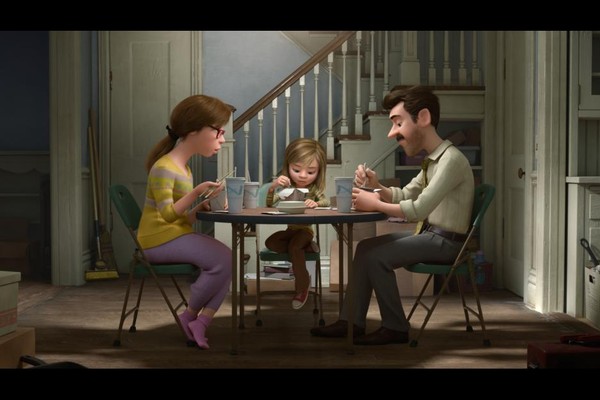
inside out riley and her family

http://www.commonsensemeda.org is an organization that can be helpful at times in giving some thoughtful insight for parents in movies that come out. Some of the parents on this site who reviewed this movie had some concerns about the incident were the main character 11-year-old Riley steals her mom’s credit card and runs away and when she is re-united with her parents that they do not have a discussion with her about these actions. Another reviewer talks about preschool children crying over sad incidents in the movie. Most of the positive reviews tended to come from parents who had older elementary children or teens.

Note:  As with all movies parents have the huge responsibility of deciding what is a good fit for their individual child and what they are ready to see. Not an easy thing. This movie is probably best for children who have some abstract reasoning in place.

We can always have discussion with our children after viewing a movie. I think one of the best part of a movie is the dialogue it creates. So if you feel there was a missing piece then by all means talk with your child about it.

If you are not feeling sure what you think as to your child seeing this movie, you could do a date night and go see it as parents first. This I think is always a helpful strategy for a movie we are not sure about. I do feel this movie does a nice job of highlighting for parents some of the core messages I mentioned above.

Best wishes in deciding if your child is ready for this one. If they are, there are some good core messages to glean from it.

Please note that pictures are taken from the Disney / Pixar website.


Feng Shui Your Heart – Letting Go of What No Longer Serves You

flower heart 7-1-15

Ever feel like your heart is heavy with sadness or anger and it just feels stuck there? Or maybe it feels all lit up with anxiety and just won’t go away.

The key is to let go of what no longer serves you.

A couple of years ago, I spent some time researching Feng Shui practices and decided I needed to Feng Shui our home. I felt like there was just too much “stuff” in our house. That it was feeling too crowded and it just did not feel soothing and pleasing to me. So I went through the house and really looked at everything with the question, “Does this bring me joy?Does it feel good to me?” At the end of the day I had a significant pile of “stuff” at the front door. And the less crowded space felt so much more soothing and pleasing to me. I had taken out what no longer served me and it let in a feeling of openness and joy. I am not completely sure my husband felt the exact same way. He did ask when he came home that night “What is all that pile of stuff at the front door for?” and I sweetly told him, “Oh, I have just been Feng Shuing our house.”

I was thinking our hearts are like our homes in that sometimes they can become cluttered with stuff we no longer need, things that no longer serve us. You may have someone who has done you wrong and it has stayed with you for a very long time. When you look at it closely you may find that you are the only one who is still re-living that upset and still feeling badly about it all.

It may be time to let go of past upsets  to make room for more joyful feelings of happiness.

Forgiveness or letting go is not about condoning or saying it was right what someone did to you, it is about letting it go so you can let the good come back into your life. You may find this to be a process, not a one time event. That is ok. But what you will find is that the more you let go, the more you will have room for the good stuff.

You may also find that your heart is filled with too much to do with not enough down time. Or you may feel certain activities or people leave you stressed or anxious. You can ask your self, “Does this activity make me feel happy or bring me joy?” Or “Do I feel this helps me fulfill what I consider my purpose or what I want to be doing?  If so there is room for this in your heart. If not, it may be time for a bit of weeding.

Letting go of those things that you really do not need or want will leave you with space for a more happy, peaceful you.

So I hope you will find time to Feng Shui your heart. You will be glad you did. Taking time to “de-clutter” your heart is well worth the effort.

“Self Talk” That Gets You Where You Want to Go

happy girl in black and white

How powerful is your “self talk”? I would say powerful enough to change your life. That is pretty powerful. It really takes you where you want to go or not go for that matter. This is why it is so very important to take notice of what you are saying to yourself. Of course the golden rule is “What you think is what you get.” When I encourage clients to use more positive self talk, I sometimes hear “But it’s not true.” This may be the case, but if your talk is negative then what follows will tend to be negative. And vice versa.

One way to move toward more positive self talk is to transition into it. I was listening to a stress reduction audio recently and was struck by the language that was being used. They were using what I am going to call  – Progressive Positive Self Talk. This is what it would sound like with some common feeling states we may want to change.

Progressive Positive Self Talk

  1. Say what YOU WANT by expressing what WILL BE HAPPENING in the near future.
  2. Talk about BEING IN PROCESS of what you want.
  3. Declare that it HAS HAPPENED!

Here are some examples:

  1. “I am going to relax.”
  2. “My body is relaxing.”
  3. “I am relaxed”

OR

  1. “I am going to calm down.”
  2. “I am feeling more calm.”
  3. “I am calm.”

OR

  1. “I am going to choose to be happy.”
  2. “I am feeling happier.”
  3. “I am happy.”

This may be helpful in getting your self to believe and buy into positive self talk. For some it may make it all a bit more believable. And this is so very important. You have to believe for positive self talk to work. 

In addition, positive self talk can help with self control or self regulation. Knowing how to regulate and shift to a feeling state that you want to have is a valuable skill.

So what do you want? Play with the wording in which you state what you want, describe it beginning to happen and say with confidence that it is happening! You will be amazed to find you can set your intent and easily make it happen. You have the power to create what you want. 

Best wishes in using this Progressive Positive Self Talk strategy!

Goal Setting with an Open, Flexible Twist

light bulb with green sprout, taken from word clip, may 14, 2015

Want to reach your goals or BETTER? I am suggesting consideration of goal setting with an open, flexible twist. This allows you to access what life offers you unexpectedly.

Being able to shift and adapt easily can change your life. When you fight changing your well laid out plans you feel frustrated and disgruntled. You may even be flat-out angry. When you are able to be flexible and go with what life presents you may find that you feel happier and so much more at peace. Plus possibly discover something even better than you originally wanted.

I am a bit of a planner and I love to have goals. In fact I encourage my clients to have goals or to set intentions as what they want from life. Having a desired intention can help get you where you want to go. And better yet if you add a “flexible twist” to it.

It is somewhat of a two-sided coin as I promote having goals and  being flexible, open and adaptable. So here is the key idea:

Set your intention or your goal with the idea that you very much desire your goal OR “something that is BETTER”.

This opens up wonderful possibilities that you may have never dreamed of. So take the limits off of your goal or intention. You may find that being open to other ideas and thoughts about something that you desire may lead you to discover something that is exceedingly better than what you originally thought of.  A few examples:

  • You are wanting to get in better shape, but you know it will be hard taking time away from your partner. Your initial goal: “I will go to the gym two days a week to keep in shape OR something BETTER.”  You may find the gym works once a week realistically, but two times not so much. So a shift to one gym trip a week and adding nightly walks with your partner keeps you in shape and gives you time with your loved one.
  • You feel you are rushed every morning and it starts your day feeling anxious. Your initial goal: “I will get up every morning at 6:30 or something BETTER.”  You may find after you experiment with your new get up time that 6:30 helps but it still feels there is no time for you, but that 6:15 gives you that extra bit of time not to feel so rushed and time for a quick meditation. You love this new mini meditation at the beginning of the day.
  • You really want to lose some weight and feel just eating less will do the trick. Your initial goal: “I will lose 10 lbs by December by eating less food or something BETTER.” You may find that eating less food is helping but the weight is not coming off the way you planned,  but when you add exercising it gives you more energy and quicker weight loss. Yahoo!”
  • You are not happy with your job. You feel you have more potential. Your initial goal: “I will find a new place of employment by the end of the year.” You may find that as you explore possibilities that a new position opens that is a perfect fit for you with room to use more of your talents at your current place of employment.”

light bulbs green with hands and feeds jumping up clip art may 14 2015

 I have to say sometimes our plans going awry may not feel like it is better way. But you know the old saying “Take your lemons and make lemonade.” Take what feels like is a not good situation and use it as a jumping board into another place that is more workable and possibly better.

I am also not suggesting that we give up on our goals when things get tough. And just go with whatever comes along, but to be open to what else may be there that is even better. This is more about thinking thoughtfully and opening ourselves and not becoming stuck in feeling our goals must develop in a very specific way.

Best wishes in developing the fine art to being flexible and open to all the wonderful possibilities the universe has to offer us!

The “Foundation Ingredient” to Finding Answers to Your Problems

catepillar animated smiling

Finding the solution to a problem is not always about just thinking and working harder on it. I had this concept come home to me again recently.  So here is a little story to illustrate this surprising key to finding the answers to problems that you are having trouble finding a solution to.

I was having a tough week, lots to do and not sure how to handle a new challenge that evolved. I had wrestled with it trying to focus and actively find a solution when I was at a point that I felt my brain was fried. I finally decided to go to bed and start anew the next day. Not a bad strategy in itself. I was so wound up I thought maybe a guided sleep meditation might help me go to sleep easier. I had recently reviewed a children’s cd that was devoted to helping children relax and cope with anxiety. I remembered one of the stories being about a harried caterpillar that was all tied up in knots. I thought ok, that’s me!

And I listened . . .  A little girl was in the meadow. She saw a caterpillar who was scurrying around all tied up in knots. She asked him “What is wrong?” The caterpillar answered that he was all tied up in knots that he had to find green leaves to eat and find a place to create a cocoon all before nightfall. The little girl giggled and said first let me help you relax. She asked the caterpillar to lie down and had him relax all of his feet and then his body, etc. until he was all relaxed. The caterpillar was no longer knotted up. He began to feel the warm sunlight and gentle breeze in the meadow.  The little girl asked  him to let all of his thoughts leave his mind and let it relax. His mind was now still and quiet and very clear. As the little caterpillar looked up he saw a beautiful tree full of juicy leaves. And a lovely branch that would be perfect for his cocoon.  So he ate and ate the juicy leaves and began his cocoon in the safe place that he was able to find when his mind was quiet and still. He thanked the little girl for her gift of helping him to relax and find the answers to his problem. All was well.


As I finished this story I felt nice and relaxed and begin to drift off to sleep. But before sleep came, I had this lovely solution pop into my head as to what to do with the challenge that had plagued me all day. I was so excited I got up and jotted down this creative and unique idea. Went back to bed and had a great night of sleep.  This was a nice reminder for me about how letting our mind rest and clear can create fertile ground for the sprouting of fresh, new ideas.

The story I have shared is a summary of “The Goodnight Caterpillar” found on Lori Light’s cd, Indigo Dreams, Track #4.  www.stressfreekids.com . This is great cd for children (and adults) for stress reduction.

tree image animated word document

This fun story is great for sleep.  But one of its key messages is that when we relax our body and our mind, clearing our thoughts and entering a quiet, still place, we can then really see the solutions for problems or worries. Letting go and unwinding and relaxing fully will bring us great rewards. Think about it. When do you find your best solutions? For me it is normally not when I am at my desk, but when I am out for a walk or taking a break from my work or just after meditating. Other times might be while I am in the shower or drifting off to sleep.

So consider not working so hard and letting the answers come to you while you are in a relaxed state. Doesn’t that sound like so much more fun!


Do I need to be playful and light-hearted to be happy and connected? It depends!

tennis shoes black and white with heart in between

Is it necessary to be playful and show your “fun” side to be happy and connected? I think this depends on what you want from your life. If you are feeling stressed and overwhelmed, you might consider the many benefits of having some “play time”. What this means will be different for different folks. There is planned play and then there is random acts of playfulness. Sometimes a mix of both. All are good for you. Play is not just for children. Let’s look at some ways that play is beneficial, some of the components of healthy, restorative play and some thoughts on both planned play and random acts of playfulness.

Benefits of Tapping Into Your Playful Self

  • It gives your overworked brain a break. In particular your amygdala, the center that alerts you if there is potential danger or harm coming your way. When your amygdala is calm, so are you. The relaxed state of play can give your brain a needed break.
  • Play gives you respite from worry and upset. When you are in a playful state, your focus has shifted away from the worries and stresses of your life.
  • Play is a wonderful medium to help you connect with your loved ones. ♥♥  Play can create a space for loving / nurturing interactions . Actually for all relationships: couples, parents and children, siblings, families.
  • A relaxed play state can help you recharge and think more clearly, allowing for more creativity and effective problem solving.  I know many of my best ideas come when I am in a relaxed state.
  • Play can aid in healing mentally or physically. Being in a relaxed, non stressed state gives our body the rest it needs to heal.
  • It can bring you joy and happiness. And isn’t that something we all want and desire!

 Components of Healthy, Restorative Play

  • Competition is not emphasized. In its purest form it would be cooperative and mutually satisfying. There can be healthy competitive play. Considering your goal would be good here. In general for all those involved, cooperative play is going to feel the best for all concerned and do more for relationship building. Competitive play can help one prepare for the competitive world we live in and develop a healthy outlook on competition, especially if developmental age and talents are considered. But for the goal of lowering stress and relationship building, cooperative play is best. If you do something with a winner / loser, keep it light. If you are doing this as a family, model a light-hearted approach to your game.
  • It is fun and all those involved are enjoying it. Basically it should be mutually satisfying for all.
  • It is inclusive. No one is left out or made to feel as it they are not a real part of the play.
  • If it is parent child or family play, it is at the children’s developmental level. If something is too far above our level of understanding or capabilities , it is stressful. This goes for children and adults.
  • It feels uplifting and positive. There is focus on fun and enjoyment. We would of course avoid criticizing or telling another what to do. This is not to say that redirecting and establishing appropriate boundaries and limits for children are not a needed component.
  • There is a healthy flow of taking turns in leading the play. It has a cooperative, shared kind of feel to it. No one person dominating.
  • It does not involve electronic devices and these are not used during your play. This would be in the purest state the most conducive for interaction. There may be some times that watching a funny movie or doing an electronic game together may be what you want. But other forms of play will bring lots of other additional benefits. Or at least keeping it balanced can be helpful between the two avenues. If you are using electronic devices you can try to remember to add in playful touches and conversation. Plus more one on one non screen interaction afterwards.
  • Healthy, fun bantering and light-hearted teasing as a couple. With children (and with some adults) it is best to gauge for sensitivity and upset with your light-hearted teasing. This is meant to be fun, not hurtful at any level.
  • Open affection and laughter is a good hallmark of healthy play.  Holding hands, hugs, kisses, friendly and open interest.
  • You feel expansive and good during and afterwards. There is a light feeling that is a part of this kind of play.

play don't forget to play pic of swing set


Planned Play

Due to the very busy lives we all lead, it is necessary to plan for times of play or opportunities for play. For some it may not happen unless it is planned. This is not a bad thing, just a necessary thing. Even within the planned times, you will find opportunities for more spontaneous, out of the box playfulness. Having set play times can be very helpful for busy couples or families. It may be a planned family activity once a week. Or a date night in which playful things are included. Or a quarterly get away for a couple to relax and play. This does not have to be far away, just a scheduled time to “be together” in a playful fun state. But most of all it is is important to remember that play is not so much about a specific get away or activity (even thought that can be fun), but more about a state of mind and attitude and blocking of time to create an atmosphere or space where it is more likely to happen. 

Some other examples:

  • Doing versions of child activities as adults or with adolescents. And of course, doing child activities with your children. This creates a fun base that encourages playfulness. Some examples: Silly String Fight. Blowing Bubbles. Slap Jack.
  • Creative activities lead to allowing for playfulness. Things such as: Arts and Crafts. Cooking. Decorating. Lego Building. Telling Stories.
  • Encouraging humor. Telling jokes. Watching funny movies together. Parents and children reading funny books together.
  • Being in nature together. Spending time outdoors creates a sense of well-being that can allow for more playful feelings.

Random Acts of Playfulness

Is there anything better than having some random acts of playfulness happening? I think not. I love this the very best myself. For example: I was at a muddy outdoor event and my husband decided to give me a piggy back ride across an especially muddy area. It was so light-hearted and fun. That was actually the high light of that fun event we attended. It just felt so playful and fun.

Random acts of playfulness are really more about acting from our playful side of our self. It is about being open to this playfulness by both people. Letting our self have this light, freeing interaction even at times that are not ideal can help relieve stress. Maybe you have a hard day, but you come home and decide to let that slide away and be with your loved one in a way that promotes a feeling of connection and playfulness. It is a lovely choice we can choose to make.

  Ending Notes 

There are times when we do need to be serious and have extreme focus.  As with so many things in life BALANCE is a real key. Your playful self is wonderfully complementary. Here is to lots of playful, connecting times ahead!

Please let me know of Random Acts of Playfulness that have occurred for you. This may give other ideas as to how to express this fun, more spontaneous side of themselves. Maybe we should all take a pledge of seeing how many Random Acts of Playfulness we can spread around this next week. What a win – win situation, for us and our loved ones!


Creating OFF Mode for Self Renewal and Better Relationships

snoopy on top his house, laying flat depressed look

When we are ON all the time we begin to feel burned out and drained and find not much left for care of ourselves or of our relationships. It actually can begin to feel addictive, this need to be ON and “plugged in”. I can attest for my own self that I  have to constantly be on guard as to how much I let things control my time. We have more power than we think we do.  There is a practical, realistic piece as to work and personal commitments.  What I  do find interesting is that so many times the more balanced we become, the more focused and purpose driven we become.  We can even accomplish more when we are in our ON work mode  all of the time. And it can feel every so good when we are ON and all of our creative juices are flowing. This is most true of course when we love our work.  It is finding that lovely balance that we all so crave. And that may be a bit different for each one of us.

But for so many it feels like we live in a crazy, busy world. So how can we switch to our OFF mode more often? Doing a bit of reflection can help to access your balance. This is a place to start.

snoop and bird on top of house looking disconnected

Are you in OFF mode enough for Self and Relationship Health?

  • What does your body tell you? You might consider how you feel physically.
  • What does your internal “gut” tell you? So many times we know when we get quiet and still for a bit to consider this.
  • Are you happy? Do you like how you are spending your time? Does it match up with your goals and desires for yourself and your relationship?
  • Do your loved ones complain that they never see you or that you don’t spend enough time with them?
  • Do you have enough contact with your family and friends that you really know what is going on in their lives?
  • Do you feel close and connected with loved ones?
  • Do you spend more time on Facebook, texting, on the internet than you do with your family? Does your “electronic world” take away from having OFF time that you need for your self renewal and your relationships?

None of us will be perfectly synced and balanced all the time with the perfect OFF / ON balance. But what we can consider is what this looks like most of the time. Plus, what is one man or women’s perfect fit is not so much for another person.

snoopy and bird playing on skateboard happy


What are Some Practical Strategies to Put More OFF Time in Your LIfe?

  1. Get very clear as to what you want for your life. How much time do you want to be in work and volunteer commitment mode? In personal self-care mode? And in nourishing your relationships? Visualizing what you want can help you get there. It will lead you to make decisions that really fit for what you want in your life.
  2. Choose carefully what you do with your time. Make it match up with what you want. This feels the most rewarding and is the least draining of our energy. 
  3. Strongly consider your personal relationship with your “electronic world”.  Decide on purpose how much time you spend with the varying media that draws us in. Facebook, texting, Pinterest, Instagram, etc, etc,
  4. Listen to your “inner voice” to keep you on track.  Setting aside a bit of quiet time each day for yourself can help you to stay in tune with what you really need.
  5. Listen to your loved ones. Really hear what they are saying. Make sense of it and take action to keep  close connections.

snoopy holding heart

Note: As I try to always “walk the talk” I will be taking a break from posting on my blog this next week to spend personal time with my family. I wish you well in your own personal journey in finding the right ON / OFF balance in your life.